Beach Water Quality Monitoring
Council conducts weekly recreational water quality monitoring and reports the test results. Additional sampling is undertaken after significant rainfall events to assess potential stormwater impacts.
See the latest water quality test results for Slaughter Bay, Emily Bay Lone Pine, and Emily Bay Outlet on Council's Facebook page. The pinned post in the Featured section is regularly updated with the latest test results.
As a general precaution, swimming at Emily Bay should be avoided after heavy rainfall or for as long as stormwater is present.
Monitoring Sites

Signs of stormwater pollution
The most obvious signs of stormwater pollution are water discolouration as well as land debris in the water and on the tide line. There is a stormwater outlet in the west end of Emily Bay that discharges during wet weather and swimming should be avoided whenever significant flow is entering the bay.
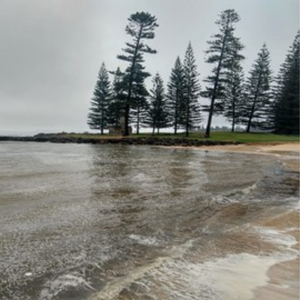
Discoloured water at Emily Bay

Emily Bay outlet

Storm water flowing at Emily Bay
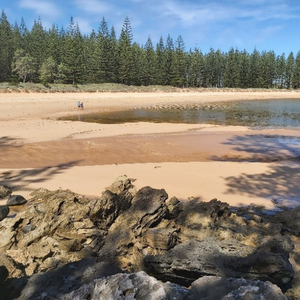
Storm water flowing into ocean at Emily Bay
When are samples collected?
Samples are collected every week. If faecal bacteria contamination is detected, samples are collected daily until bacteria levels drop.
Enterococci Water Monitoring - Beaches(XLSX, 18KB)
What do we test for?
We test water samples for a bacteria called enterococci. Enterococci is found in the intestines of warm-blooded animals and excreted in faeces. It is minimally present in unpolluted waters and an elevated concentration is used as an indicator for potential pollution.
Studies have shown a strong relationship between elevated levels of enterococci and illness rates in swimmers. So, to protect public health, the ongoing monitoring of enterococci is essential. Indicator organisms are used to test for sewage pollution because:
- the expected levels in unpolluted waterways are known
- they are easily detectable by simple laboratory tests
- results are reliable with a quick turn around and response time (24h).
The National Health and Medical Research Council (2008) Guidelines for Managing Risks in Recreational Waters (link is external) recommend enterococci as the single preferred indicator organism for the detection of faecal pollution.
How do we interpret the results of the tests?
The table below shows how the enterococci results are interpreted and categorised
| Enterococci reading (MPN/100ml) |
Description |
Categorisation |
| <41 |
Good |
Green |
| 41-200 |
Fair |
Orange |
| 201-500 |
Poor |
Orange/Red* |
| >500 |
Bad |
Red |
*Subject to interpretation based on conditions and forecasts

Examples of Enterococcus results – Left - Green, Middle - Orange, Right - Red
What happens when contamination is detected?
When test results indicate faecal contamination, the sampling site is immediately retested, and a public health warning is issued via our website and Facebook.